England Market Access for MedTech, Diagnostics & Digital Health
The UK healthcare market combines nationally defined health technology assessment and policy frameworks with increasingly system-level commissioning and funding decisions.
For MedTech, diagnostics and digital health companies, successful market access requires an understanding of how regulatory requirements, health technology assessment, NHS commissioning, coding, reimbursement and local adoption interact.
This overview provides an introduction to the key market access considerations for health technologies entering the UK market.
England Market Access at a Glance
Healthcare System
Publicly funded healthcare delivered through the NHS, with England operating its own commissioning and delivery structures.
HTA & Evidence
NICE evaluates health technologies and provides evidence-based recommendations that can influence NHS adoption and commissioning.
Reimbursement
Payment for NHS-funded care depends on the setting and pathway, with national and local payment arrangements interacting with coding and service structures.
Funding & Commissioning
Understanding who commissions and funds a technology is critical, as access decisions may involve national, system-level or provider-level stakeholders.
1- Healthcare System & Reimbursement Landscape
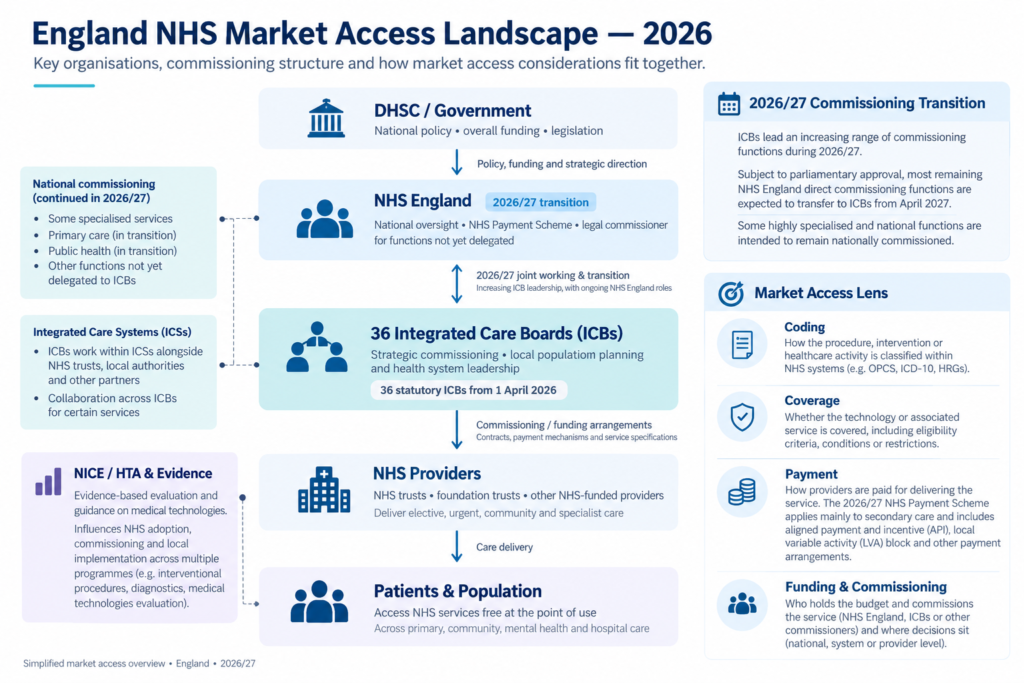
England operates a predominantly publicly funded healthcare system through the National Health Service (NHS). NHS healthcare is largely funded through general taxation and provides broad access to primary, hospital and mental health services, with most NHS care free at the point of use.
For medical technology companies, market access extends beyond regulatory approval. Understanding how a technology fits within the NHS care pathway, how the associated service is coded and paid for, who is responsible for commissioning and funding the service, and what evidence is required to support adoption are important components of reimbursement planning.
Reimbursement Framework
For market access analysis, reimbursement can be considered through three interconnected dimensions:
Coding
How the procedure, intervention or healthcare activity associated with the technology is identified and classified within NHS systems.
Coverage
Whether the technology or associated service is covered, including any eligibility criteria, conditions or restrictions that may influence access.
Payment
How NHS providers are paid for delivering the associated healthcare service, including the applicable national or locally determined payment mechanism.
The NHS Payment Scheme (NHSPS) establishes rules governing payments between commissioners and providers for NHS-funded secondary healthcare.
Reimbursement = Coding + Coverage + Payment
CODING
How is the service identified?
Procedure • Diagnosis • Activity
COVERAGE
Is the technology or associated service covered?
Eligibility • Conditions • Restrictions
PAYMENT
How is the provider paid?
Payment mechanism • Rate • Setting
Funding & Commissioning Landscape
Integrated Care Boards (ICBs) have a central role in planning and commissioning healthcare services for their local populations. England currently has 36 ICBs, following organisational changes that took effect on 1 April 2026.
Commissioning responsibilities are continuing to evolve. During 2026/27, ICBs are taking a greater leadership role alongside NHS England, with most remaining direct commissioning functions expected to transfer to ICBs from April 2027, subject to parliamentary approval.
For health technology companies, identifying the relevant commissioner, funding responsibility, provider setting, and decision-making level is an important early step in understanding the market access pathway.
2 - Coding & Payment Mechanisms
Payment for NHS-funded secondary healthcare in England is governed by the NHS Payment Scheme (NHSPS). Payment arrangements vary according to the type of care, service and contractual arrangement between commissioners and providers.
Healthcare Resource Groups (HRGs) are used to group clinically similar healthcare activities that consume similar levels of resources. HRGs can be informed by clinical coding, including OPCS-4 procedure codes and ICD-10 diagnosis codes, and continue to play a role within NHS payment and costing structures.
For medical technologies, understanding whether the technology is incorporated within an existing payment arrangement—or requires consideration of a separate funding route—is an important part of reimbursement analysis.

3 - Health Technology Assessment & NICE
The National Institute for Health and Care Excellence (NICE) plays an important role in the evaluation and adoption of health technologies in England. NICE guidance can influence commissioning, clinical practice and the uptake of new technologies within the NHS.
NICE’s HealthTech programme evaluates medical devices, diagnostics and digital technologies, considering their clinical and economic value to patients and the health and care system. The programme now brings together several former NICE evaluation routes within a unified framework.
The approach to evaluation can vary according to the technology and its stage of development, including early use, routine use and existing use. Understanding the appropriate NICE pathway and its evidence requirements is therefore an important component of market access planning.

4 - MedTech & Diagnostic Considerations
Market access pathways for medical devices and diagnostics in England depend on the technology, clinical setting, care pathway and associated funding arrangements.
For many medical technologies, the cost of the device or diagnostic may be incorporated within the broader cost of delivering a healthcare service rather than reimbursed separately. Certain high-cost technologies may be subject to different funding or payment arrangements.
For diagnostic technologies, market access may also depend on where testing is performed, how laboratory or diagnostic services are funded, and whether the test forms part of an established clinical pathway.
Identifying the care setting, relevant commissioner, existing payment mechanism and evidence requirements is therefore important when assessing the potential route to NHS adoption.

5 - Digital Health Market Access
Digital health technologies can face distinct market access considerations depending on their intended use, clinical function and position within the NHS care pathway.
Access may involve demonstrating clinical value, economic impact and benefits to patients or the healthcare system, while the relevant evidence and evaluation route can vary according to the type and maturity of the technology.
For digital technologies intended for NHS adoption, understanding the evidence expectations, evaluation pathway, commissioning environment and potential funding route can help inform market access planning from an early stage.
6 - England Market Access Pathway
The route to NHS adoption varies according to the technology, care setting and funding pathway. A market access assessment typically considers several interconnected elements from early pathway positioning through to commissioning and adoption.
Care Pathway
Where does the technology fit within current clinical practice?
Coding & Payment
How is the associated activity coded and paid for?
Evidence & HTA
What clinical and economic evidence is required?
Funding & Commissioning
Who is responsible for the funding or commissioning decision?
NHS Adoption
What is the route to implementation and uptake?

Independent consulting in market access and reimbursement strategy for MedTech, diagnostics, and digital health technologies.
Supporting companies in understanding reimbursement pathways, HTA landscapes, and payer environments across global healthcare markets.